
14 October 2024
“There ain’t no meat on the legs.” I’m not saying nonc was wrong back in the day when we would only take the breast meat and the gizzards from the ducks that we’d just shot that morning. I understand that time was and always is of the essence, and that it takes a lot of work to pluck and clean a whole duck, especially if they got skinny legs. All I’m saying is that, with perfect 20/20 hindsight, most times we were leaving some of the best possibilities of taste on the table: particularly the flavors from the bones and rendered fat that come out during a low and slow stewing/braising process.
Now don’t get me wrong, occasionally we would bring some whole ones back (particularly teal), begrudgingly pluck em, brown em in an old cast iron pot with some onions, then stew down till fall-off-the-bone tender and serve with a bowl of rice. That version of rice and gravy was always my favorite. There’s such a depth and range of flavors that come from duck, especially wild duck, that a chicken or turkey or bec-croche could never have. Plus, that old cast iron pot, no matter how much you clean it (without soap of course), keeps the memories and flavors of dishes past that add an authentic, unmistakable layer to whatever you cook in there.
Sure, there’s a million ways to make a gravy for rice and gravy in Louisiana: from stewed chicken, turkey necks, Vienna sausage, and if times are tough/you’re in a pinch, from a packet. They’re all good in their own way and were a staple for me growing up. But as far as I know there ain’t none like Lor ark, or Hokkien braised duck. Hokkien refers to a dialect of Mandarin Chinese and/or a person originating from the south eastern providence of Fujian. Over time people from that region spread throughout Southeast Asia and brought their customs, language, and recipes with them, just like Cajun people brought parts of their homeland with them to south Louisiana. Lor ark is a whole duck braised in a dark soy sauce-based broth infused with aromatics such as five spice powder (kinda like Chinese Tony Chachere’s), ginger, garlic, cinnamon, star anise, and cloves. Once the duck is cooked, it’s removed and hardboiled eggs and extra firm tofu (tua kwa) are added to the braising liquid to serve with the duck.
While this dish can be found throughout Southeast Asia in various, localized forms, the one I’m sharing here is from Singapore, known locally as duck rice. This version actually has a couple of parts, the first of which is the braised duck based on traditional Lor ark recipes. This blog post will focus on the duck part, while the sides (rice, broth, chili dip) I’ll get to in the next post. The first time I had duck rice in Singapore it instantly reminded me of the rice and gravy made from those stewed ducks back in Louisiana. Not that the flavors are in any way similar to each other, but the presentation and end result were almost identical: slow cooked, tender duck meat served with a brown sauce/gravy over rice. What’s not to like?
While the Cajun version is heavier, with a thicker and more one-dimensional gravy (oh but what a beautiful dimension it is), the gravy of the Singaporean version is much lighter, almost refreshing in the way that the soy sauce is balanced by the sweetness of the sugar and the complexity of the aromatics. The rice can be presented in a number of ways, but the traditional way to serve this dish is with yam rice (more on that in the next blog). Also on the side is served with a bowl of clear broth that looks so simple and unassuming, yet is so deeply flavored and accompanies the duck rice perfectly. And it doesn’t stop there: it also usually comes with a small side dish of a vinegar chili dipping sauce which adds spicy to the already complex flavor profile. Oh, and I didn’t even mention the duck. Braised for about an hour with all those flavors? How could that be anything less than delicious?
All of that to say that this is one of the best things you can eat anywhere. Each part of this dish, deeply rich and complex own its own right, balances perfectly with each other to create an incredible eating experience. Throughout this blog I’ll probably end up saying that this or that dish is the best anywhere, but it’s one of those things that somehow always ends up being true.
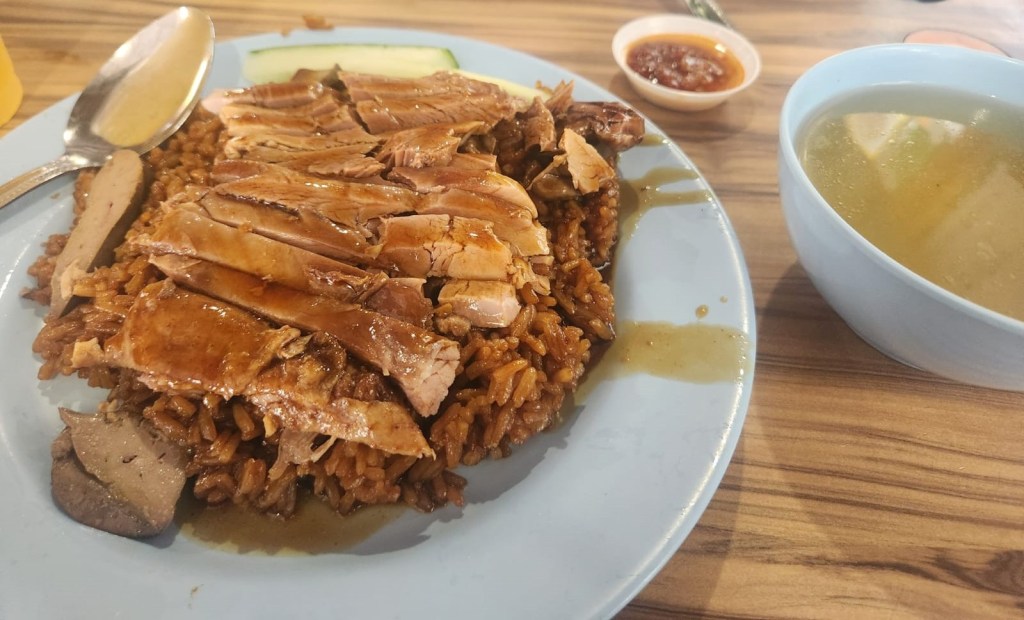
If you ever get the chance to visit Singapore, I highly recommend that you do. Not only is it a mixing pot of cultures and foods, but it’s incredibly safe, easy to get around, and absolutely beautiful. Plus, food centers or hawker stalls can be found just about everywhere, and represent the best of Singaporean food in a humble, affordable, diverse, and delicious way. For duck rice specifically, I’ve had it at quite a few places around the island, but the picture here is from Cheok Kee Boneless Braised Duck at the Geylang Bahru food center. The most well known are Chuan Kee Boneless Braised Duck and Ah Heng Duck Rice. But don’t take my word for it: this stuff is so good even the Michelin Guide keeps a list of the best.
How ya make it?
Get that big cast iron pot out for this. While traditionally this dish is almost always cooked in a large wok, I don’t see why that big Dutch oven wouldn’t work here. For the duck you could use a store-bought one, but I would bet that a wild one would be even better. Just make sure you pick the bb’s out before cooking and double check with nonc that he’s not still using lead shot. You’re gonna want the whole duck, so pluck all the feathers and take out the innards, keeping the liver, gizzard and heart.
You’ll start by rubbing the duck all over with coarse salt, both inside and out. This is pretty common in Chinese cuisine, and not only does it sort of exfoliate and open up the skin, it can also help remove any impurities from the outside. After you rub it with salt, leave it on there and let it sit for about half an hour, then rinse it off with cool water. Pat it dry with paper towels to remove as much water as you can. From there you gonna rub a mixture of dark soy sauce (which is just a thicker and less salty soy sauce) and five spice powder (mais, they got both of those at Walmart) all over the duck and let marinate for an hour. If you can’t find the dark soy sauce, regular soy sauce would work too, just add a pinch of sugar to it.
Now if the next part goes wrong, and you ruin tantes good pot, don’t blame me. But the traditional way to make this is to cook some sugar at the bottom of the pan (essentially making caramel), and then cook the duck in the molten sugar before adding the braising liquid. Now y’all been making rouxs your whole life, so this shouldn’t be a problem. But the way I like to do it is just add the sugar to the soy sauce/five spice mix so it dissolves, then brown the marinated duck. The idea is you need to get that rich, brown caramel color and flavor to stick to the duck before you add the liquid. The same way you have to brown the meat before you add your liquid and pasta to the pastalaya. That’s where the flavor comes from. Is there anything worse than a pale pastalaya?
Anyway, either way you do it, you wanna brown the duck on each side for a couple of minutes, then add a couple of cloves of chopped garlic, a small finely chopped onion or shallot, slices of a 1-inch piece of ginger (peeled like in Blog #2), and sauté for a minute or two. Then add enough water to cover the duck, about a cup of dark sauce, half a cup of regular soy sauce (or 1.5 cup of regular), a couple of cinnamon sticks (not the powder), a couple of star anise and whole cloves, a teaspoon of the five spice powder, and a pinch of salt and sugar. Again, Walmart got all that.
Bring it up to a boil, reduce to a simmer, cover and cook for about an hour, depending on the size of the duck. You can rotate it every fifteen to twenty minutes so that it cooks evenly. At around the halfway mark you can add the innards that you kept from earlier. Once the duck reaches the desired tenderness, remove from the pot and let cool to room temp before cutting. DO NOT throw out the cooking liquid. Add some peeled, hardboiled eggs to the pot and let those sit and absorb all those awesome flavors. Once cooled, you can cut the duck however you want, but just keep in mind that it should be served in bite-sized pieces so you can easily enjoy with the other parts of this dish. But more on that in the next blog.
Allons manger!
 The Cajun World Eats
Leave a comment